Enterprise Data & AI Architect Cheat Sheet: Platform Selection and Leadership

A multi-cloud guide to selecting data, integration, search and AI tools, managing scope and risks, and preparing for client and leadership meetings.
Scenario: An enterprise Data & AI Architect is advising business, engineering and executive stakeholders across AWS, Azure and Google Cloud. The estate includes analytics platforms, SaaS applications, data lakes, search, machine learning and generative AI. The objective is to choose a small, supportable toolset that meets business outcomes, security needs, delivery commitments and cost targets.
Architect’s principle: Select platforms by workload and operating constraints—not by feature overlap or product popularity. Similar names do not mean interchangeable capabilities, and multi-cloud availability does not guarantee identical features or regional support.
Start with the business question
Before comparing products, define the business outcome and the workload that must deliver it. Capture:
- Outcome: Which decision, customer journey, control or reporting process should improve?
- Data shape: Structured tables, semi-structured events, files, documents, images or vectors?
- Workload: Batch ETL/ELT, streaming, lakehouse engineering, SQL analytics, federation, search, model training or inference?
- Service levels: Required freshness, latency, concurrency, recovery, availability and retention.
- Constraints: Data residency, privacy, security, existing cloud, skills, support, procurement and interoperability.
- Success measure: Baseline, target, owner and measurement window for business value, cost and quality.
Write these assumptions down before drafting the target architecture. Keep unknowns visible and prove the highest-risk assumptions with a small, representative pilot.
Platform selection cheat sheet
Compare products by their primary role. A product can offer secondary features, but the operating model and workload fit still determine whether it should be the default choice.
- Databricks — lakehouse engineering, Spark, streaming, SQL and ML/AI: Consider it when code-first distributed processing, data science close to object storage, open table formats or complex transformations are central. Evaluate governance, job and SQL compute cost, workspace boundaries, workload isolation and the team’s operational skills.
- Snowflake — managed cloud data platform and SQL analytics: Consider it for SQL-first warehousing, separated compute workloads, managed operations and governed data sharing. Benchmark representative queries; model warehouse sizing, concurrency, idle time, credits, storage and cross-cloud movement.
- Dremio — open lakehouse query and catalog patterns: Evaluate it when teams need SQL analytics over lake data, interoperability around open formats such as Iceberg, or reduced data copying. Prove catalog ownership, security propagation, query performance, concurrency and data lifecycle responsibilities.
- Starburst / Trino — distributed SQL and federation: Evaluate when users need SQL across heterogeneous sources or lake catalogs without first centralizing every dataset. Test source pushdown, connector behavior, latency, source load, access control and transfer charges.
- Elasticsearch — full-text, vector and hybrid search: Use it for application search, logs, relevance ranking or retrieval that combines exact keywords with semantic similarity. Treat the index as a search-serving layer; define its source of truth, refresh path, retention, shard plan and relevance evaluation.
- SnapLogic — iPaaS and application integration: Use connector-led integration and workflow orchestration where it reduces delivery effort. Verify connector entitlements, runtime/network placement, throughput, retry/replay behavior and which transformations should remain in the analytics platform.
- Stacksync — real-time two-way application synchronization: Consider it for CRM/ERP and database synchronization where changes must flow in both directions. Define field ownership, conflict resolution, delete behavior, audit history, loop prevention and latency expectations.
- Vertex AI — Google Cloud AI/ML capabilities: Consider it when data, identity, model lifecycle and ML operations are GCP-centered. Validate model and region availability, quota, endpoint cost, evaluation, safety and current service naming.
- Amazon SageMaker AI — custom ML lifecycle: Consider it for model development, training, tuning and managed deployment in AWS. Measure training and endpoint utilization; distinguish custom model lifecycle needs from managed foundation-model inference.
- Amazon Bedrock — managed foundation-model application building: Consider it for inference and GenAI applications using supported provider models. Confirm model/region availability, quotas, token cost, privacy terms, guardrails, retrieval quality and current agent feature status before implementation.
- Claude — Anthropic model family: Select only after task-specific quality, latency, safety and cost evaluation. Model IDs and availability can change; version prompts and evaluations, and test replacements before upgrading.
- Cloudflare — edge and application developer platform: Consider it for globally distributed app logic, edge delivery and lightweight application services. Validate data volume, consistency, analytics, residency and network boundaries before using it for data-platform workloads.
- Other focused tools: dbt for SQL transformation; Airflow or Prefect for orchestration; Kafka, Pub/Sub or Kinesis for streaming; Fivetran, Airbyte or Informatica for ingestion; Power BI, Looker or Tableau for BI; Pinecone, Weaviate or Milvus for vector retrieval. Add one only when a defined capability and owner justify its ongoing cost.
How the services fit together
A useful architecture separates integration, the primary data plane, search and model serving. Keep one authoritative system of record per data product; use a second platform only when it provides a measurable capability and has an operating owner.
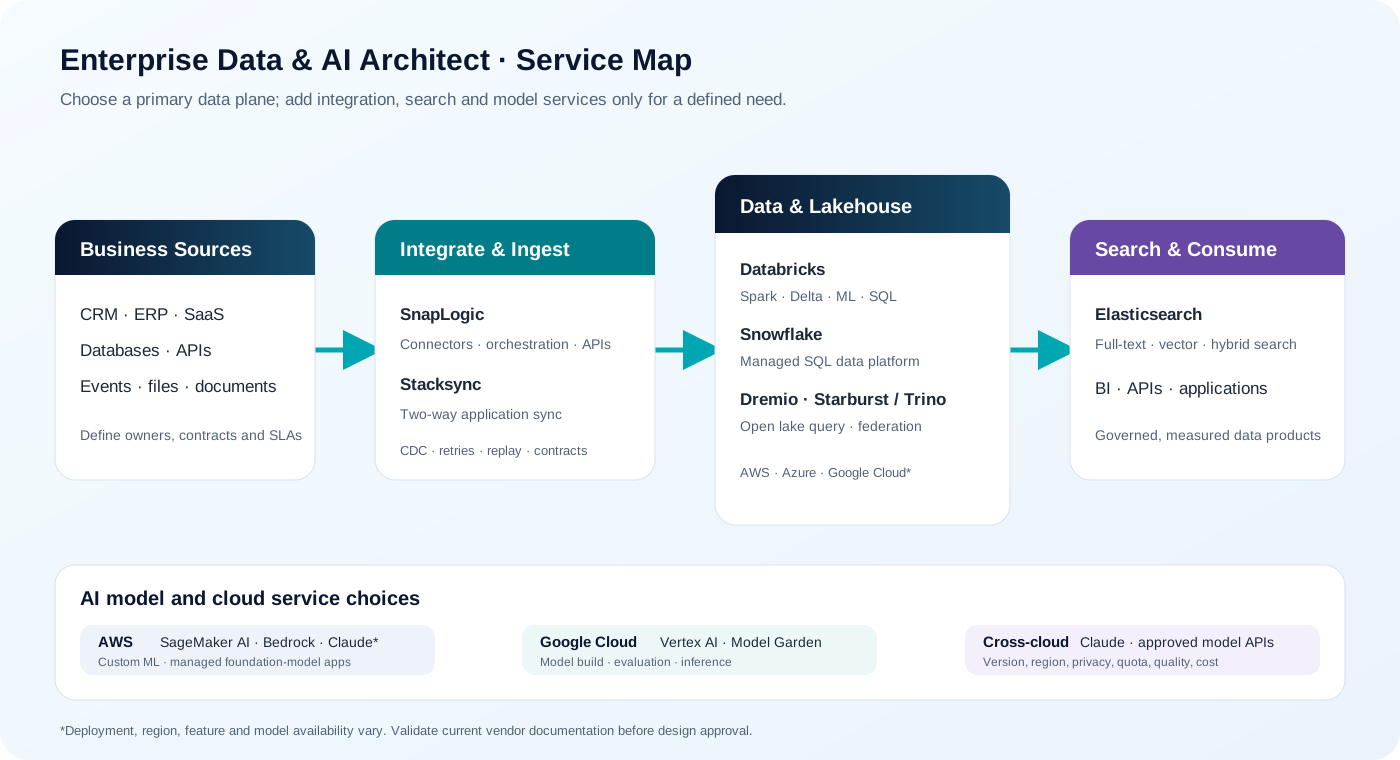
Reading the map: SnapLogic and StackSync address application integration patterns; Databricks and Snowflake serve broad analytics/data-platform workloads; Dremio and Starburst are options for lake query and federation; Elasticsearch serves search and retrieval; Vertex AI, SageMaker AI and Bedrock are cloud AI services, while Claude is a model family available through selected providers. Validate the exact deployment, integration and region for each choice.
Three-cloud selection considerations
- AWS-centered: SageMaker AI and Bedrock are AWS-native options; Databricks and Snowflake can also run on AWS. Check IAM, VPC/private routes, S3 access, quotas, regional services and cross-region or cross-cloud transfer.
- Azure-centered: Databricks and Snowflake are available; Dremio deployment type and region matter. Check Entra identity, VNet/private connectivity, ADLS, workspace security and integration runtime placement.
- Google Cloud-centered: Vertex AI is the GCP AI platform; Databricks and Snowflake can also run on GCP. Check service accounts/IAM, VPC controls, Cloud Storage access, regional features and cross-cloud network paths.
- Across all clouds: Confirm contractual data residency, encryption/key ownership, private connectivity, catalog/lineage coverage, support boundaries, skills, procurement, disaster recovery and egress. “Available on all clouds” does not mean parity of features or price.
How to control scope creep
- Restate the baseline: Business goal, in-scope domains and datasets, environments, acceptance criteria, owners, milestones and SLA.
- Record the change: Capture what is requested, who needs it, why now, and how success will be accepted.
- Assess impact: Estimate engineering, testing, security, licensing, cloud cost, dependencies, support and schedule impact. Include uncertainty and the critical path.
- Offer choices: Defer to a later release, swap out lower-value scope, add approved time/people/budget, or accept a documented SLA or quality trade-off.
- Get a decision: Update the backlog, plan and acceptance criteria only after the accountable decision owner agrees. Do not accept additions silently in a meeting.
When delivery is behind the roadmap
Tell the client early and factually. Share the committed outcome, what is complete, the current gap, verified cause, downstream impact and recovery options. Provide a forecast with confidence, owners and checkpoints. Identify systemic blockers through the agreed escalation route.
Example: “The source-to-curated pipeline is validated, but an API quota change and a late schema update put the dashboard milestone at risk. We estimate four working days to recover and will confirm after tomorrow’s replay test. We can preserve the date by deferring the optional segment, or keep full scope and move the demo. Which option best protects the business outcome?”
Record the decision and action owners, then update the roadmap, risk log and acceptance criteria. If confidence is low, state what evidence is still needed instead of presenting a precise but unsupported date.
What to start with each day
- Scan production signals: Failed jobs, freshness/SLA breaches, security alerts, spend anomalies, model/agent incidents and unresolved incidents.
- Choose three outcomes: One delivery decision, one risk reduction and one stakeholder alignment task.
- Check dependencies: Confirm owners, due dates, acceptance tests and escalation points for the highest-impact blockers.
- Align the team: Share priorities, risks, needed decisions and named owners.
- Protect focus: Reserve time for architecture review, mentoring and design work; batch routine messages.
- Close the loop: Update decision records, architecture diagrams, risk register and tomorrow’s priorities.
Prepare for client and higher-management meetings
Client meeting
- Know the business KPI and the decision the client needs to make.
- Review scope, milestone, RAID log, dependencies and open actions.
- Bring a simple current/future diagram and at least two viable options with trade-offs.
- Rehearse the demo with approved data, including a backup and failure path.
- End with decisions, action owners, dates and acceptance criteria.
Senior-management meeting
- Prepare a one-page brief: objective, outcome, RAG status, trend and next milestone.
- Show value and variance against baseline; distinguish actual results from forecasts.
- Raise material risks early with probability, impact, mitigation and residual exposure.
- State the decision or approval needed, deadline, options and recommended choice.
- Translate technology into customer experience, revenue, compliance, resilience or cost impact.
- Keep technical evidence in backup material; do not hide a bad status in dense slides.
After the meeting, repeat the decision and actions in writing on the same day, and update the agreed source-of-truth plan.
Risk and mitigation checklist
- Platform sprawl: Maintain a capability map and require an owner, business reason, total-cost estimate and exit plan for each new platform.
- Cloud/region mismatch: Validate region, service feature, identity, connectivity, support and legal constraints in a proof of concept.
- Cost/SLA optimism: Benchmark peaks, retries, storage lifecycle, network transfer, concurrency and recovery; assign alert and budget owners.
- Unclear scope: Define measurable acceptance criteria, decision rights, change control and demo cadence at kickoff.
- Integration rate limits: Use bounded concurrency, backoff, checkpoints, idempotency, dead-letter/replay paths and quota escalation.
- Data privacy or lineage gaps: Classify and mask PII, enforce least privilege, capture lineage and audit access end-to-end.
- AI hallucination or unsafe actions: Ground responses in authorized evidence, evaluate fixed cases, allowlist tools, require approval and set budgets/kill switches.
- Model/provider change: Use model adapters and versioned evaluations; re-test before changing model versions.
- Team burnout and key-person risk: Pair on critical components, rotate support, keep runbooks current and limit work in progress.
One-minute architecture decision checklist
- What business outcome or user journey improves?
- What are the data volume, latency, concurrency, recovery and retention needs?
- Where do data, identity, skills, contracts and ownership already live?
- Can the design meet privacy, residency, security, audit and support needs?
- What is the measured cost per outcome, including failures and recovery?
- What is the smallest useful pilot, acceptance threshold and stop/go decision?
- Who owns the platform, data product, SLA, support path and exit decision?
Closing note: Strong architecture joins technical judgment with disciplined communication. Choose services after framing the workload, make trade-offs visible, keep scope changes explicit and bring stakeholders decisions instead of surprises.
Explore more practical guides and register with Khojdo: https://khojdo.in/
Official product references
- Databricks lakehouse concepts and medallion architecture.
- Snowflake key concepts and supported clouds.
- Dremio overview; Starburst/Trino documentation.
- Elasticsearch vector search and hybrid search.
- SnapLogic and Stacksync documentation.
- Google Cloud Vertex AI; Amazon SageMaker AI; Amazon Bedrock.
- Anthropic Claude model lifecycle guidance; Cloudflare developer platform docs.