Petabyte-Scale Data Integration: AWS, Databricks and Snowflake from Ingestion to Operations
A practical guide to petabyte-scale batch and real-time integration across AWS, Databricks and Snowflake, covering ETL vs. ELT, API throttling, late data, watermarks, skew, S3 lifecycle, DAG operations, ROI and measurable SLAs.
At petabyte scale, data integration is a capacity and operating-model problem as much as a pipeline problem. A durable design separates historical backfills from continuous updates, keeps source data recoverable, limits work to changed data, and measures how long it takes for complete, trusted data to reach its users.
A reference flow
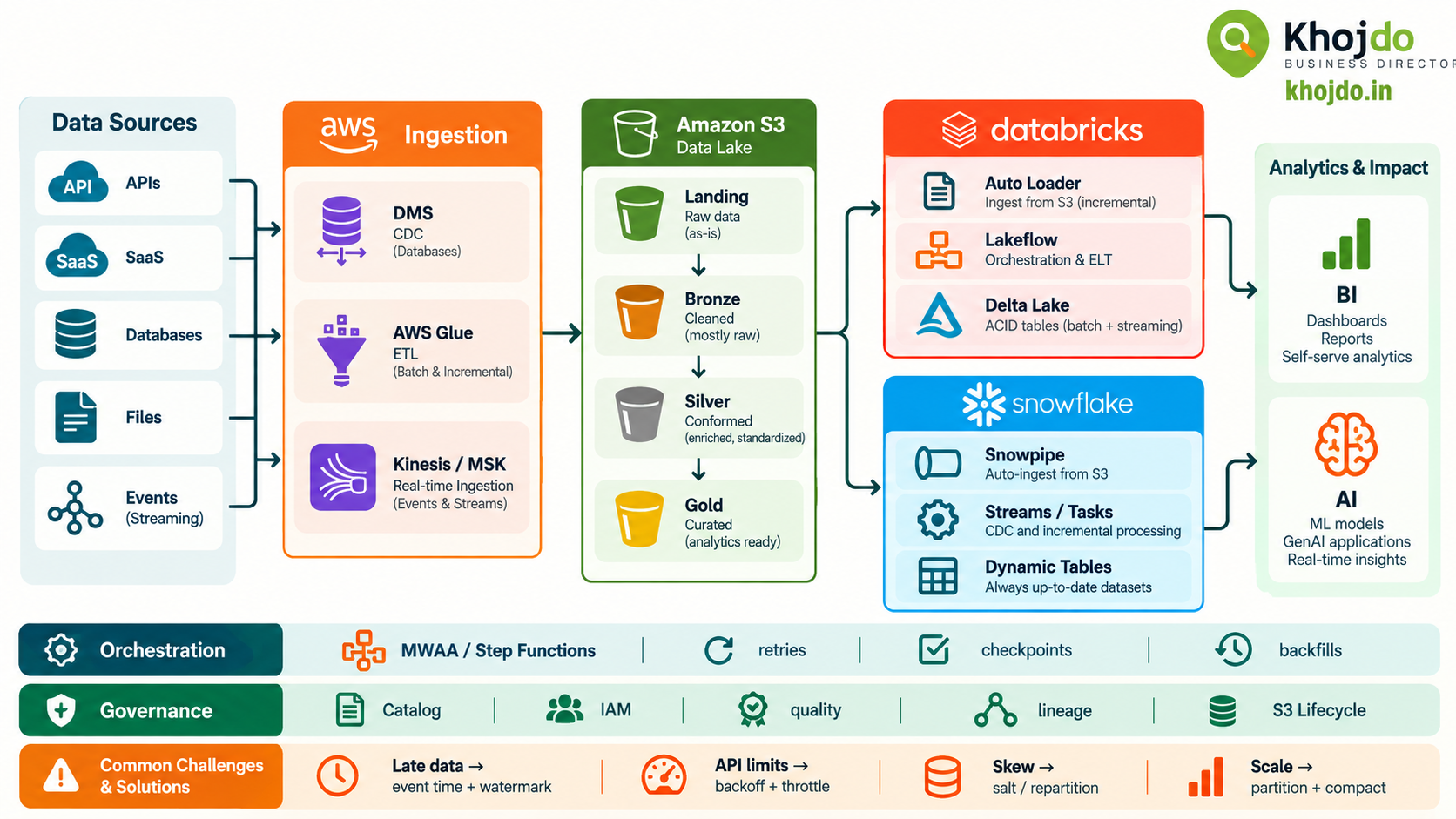
APIs, SaaS platforms, operational databases, files and event streams feed governed landing zones in Amazon S3. Batch and change-data-capture (CDC) paths handle database changes; event services handle streaming; file discovery handles object arrivals. Databricks or Snowflake then transforms and serves the data according to workload needs. An orchestrator coordinates dependencies, retries, recovery and monitoring.
For a large historical load, partition the backfill into bounded, restartable units and control concurrency against source and target capacity. Run ongoing changes separately, checkpoint progress, and reconcile totals and keys after each migration window. Benchmark representative data and workload patterns before committing to throughput or cost estimates.
Create a free account to read the rest
This article is open to registered readers. Signing up takes a minute and costs nothing.