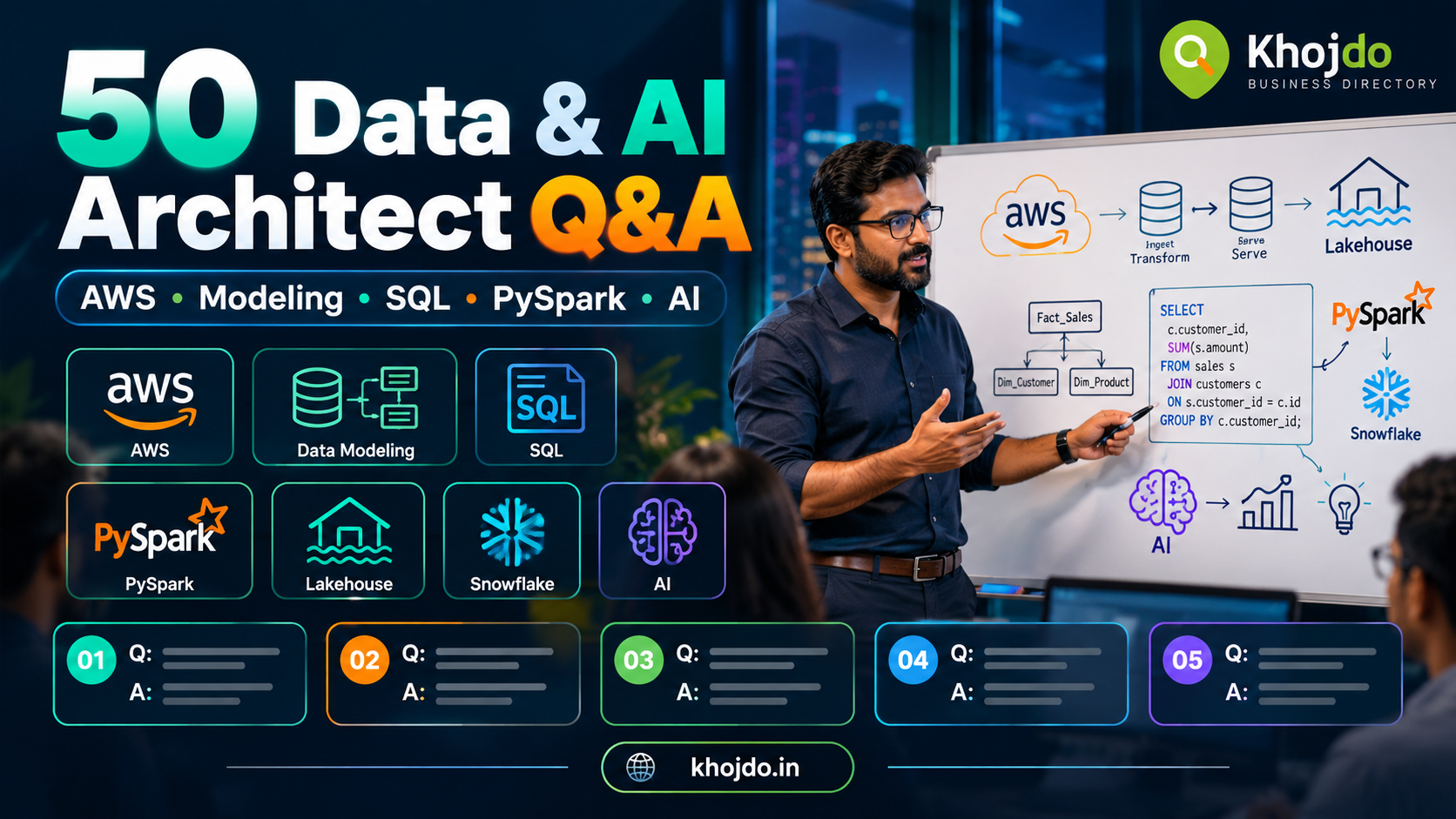
Data & AI Architect Interview Questions and Answers: AWS, Redshift, Databricks and Snowflake
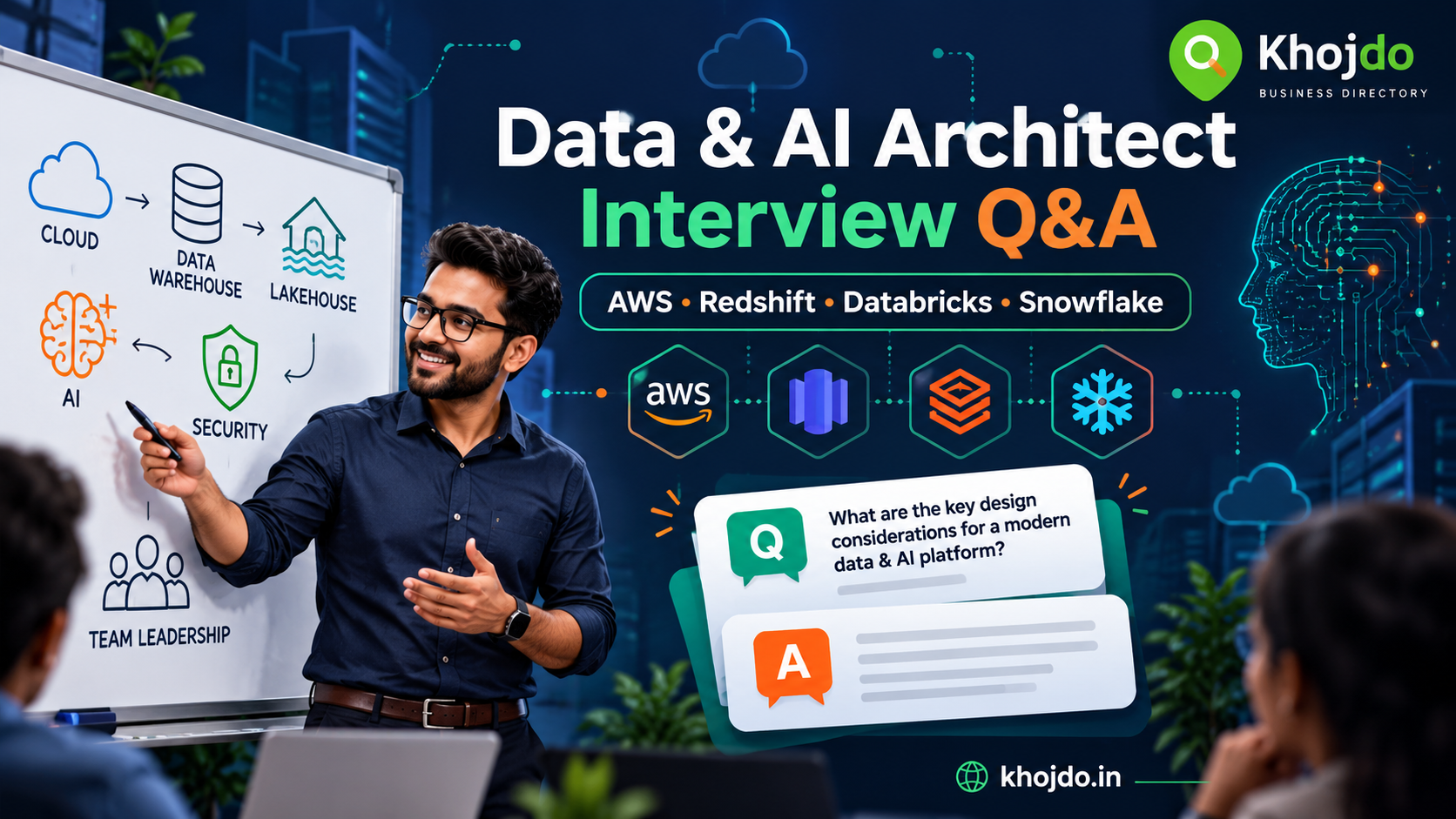
Concise Data and AI Architect interview questions and model answers covering AWS platform design, S3, Redshift, Databricks, Snowflake, data quality, governance, performance, GenAI, migration and leadership.
This concise interview guide covers architecture decisions, AWS services, data quality, governance, performance, migration and AI. Use the answers as frameworks: explain the trade-offs, name the assumptions, and connect the design to business outcomes.
Architecture and platform selection
1. How would you design a modern AWS data platform?
Answer: I would begin with business use cases, data classes, freshness needs and service levels. A typical pattern lands source data in S3, catalogs it with AWS Glue, governs lake access with Lake Formation and IAM, transforms it with Glue or Databricks, and serves analytics through Redshift or Snowflake. I would add ingestion, orchestration, monitoring, security and CI/CD based on the requirements, then validate the design with a representative workload.
2. When would you choose Redshift, Databricks or Snowflake?
Answer: I would choose Redshift for AWS-centered SQL warehousing and BI when its managed warehouse model fits the workload. I would choose Databricks for Spark-based data engineering, lakehouse, streaming or ML workflows. I would choose Snowflake for managed SQL analytics and data sharing where its platform and governance model fit. I would benchmark cost, concurrency, skills, data movement and governance rather than assuming one platform is best for every workload.
3. What is the role of Amazon S3 in a lakehouse?
Answer: S3 provides durable object storage for raw, refined and curated data, archives and data exchange. I would use clear ownership, encryption, access controls, lifecycle rules and documented retention. For analytics, I would choose suitable columnar formats and avoid excessive small files or high-cardinality partitions.
4. How do you model analytical data?
Answer: I define the business grain first. For a sales mart, one fact row could represent one order line, joined to dimensions such as date, product, store and customer. A star schema is often straightforward for BI; normalization may help where shared hierarchies or update consistency justify the extra joins. I document metric definitions and validate totals against source systems.
5. How do you choose ETL versus ELT?
Answer: I use ETL when data must be filtered, masked or standardized before it reaches the destination. I use ELT when the target platform can securely store raw data and scale transformations there. For example, I might remove restricted fields before sharing data, then use ELT to build reporting tables from a protected raw landing zone.
Operations, governance and performance
6. How would you improve a slow Redshift workload?
Answer: I would inspect query plans, workload metrics, data skew and scan volume first. Then I would tune SQL and table design based on query patterns: sort keys for useful filtering and ordering, and distribution to reduce data movement where appropriate. I would also consider automatic table optimization and test changes with representative data.
7. How do you control data access across the platform?
Answer: I use least-privilege roles and groups, separate operational duties, encrypt data, and audit access. For S3 lake data, Lake Formation can provide fine-grained permissions alongside IAM controls. Redshift, Databricks and Snowflake each need their own access policies; controls do not automatically follow data copied between platforms.
8. How do you improve data quality?
Answer: I define measurable rules with business owners—for example, order IDs must be present and unique, quantities must be positive, and source-to-target totals must reconcile. I validate at ingestion and transformation boundaries, quarantine invalid records, track trends and define an owner and replay process for failures.
9. How do you handle schema changes and late-arriving data?
Answer: I version data contracts, classify compatible and breaking changes, test consumers and communicate changes before deployment. For late data, I retain both event time and ingestion time, define an allowed-lateness policy, and use idempotent merge or correction logic so reprocessing does not create duplicate facts.
10. How do you reduce cloud data costs?
Answer: I measure cost by workload and business outcome. I use incremental processing where practical, right-size compute, reduce unnecessary scans, compact files, apply retention rules and monitor transfer and retrieval charges. I validate savings against performance and recovery needs so cost reduction does not break the SLA.
AI and migration
11. How would you build a grounded GenAI assistant?
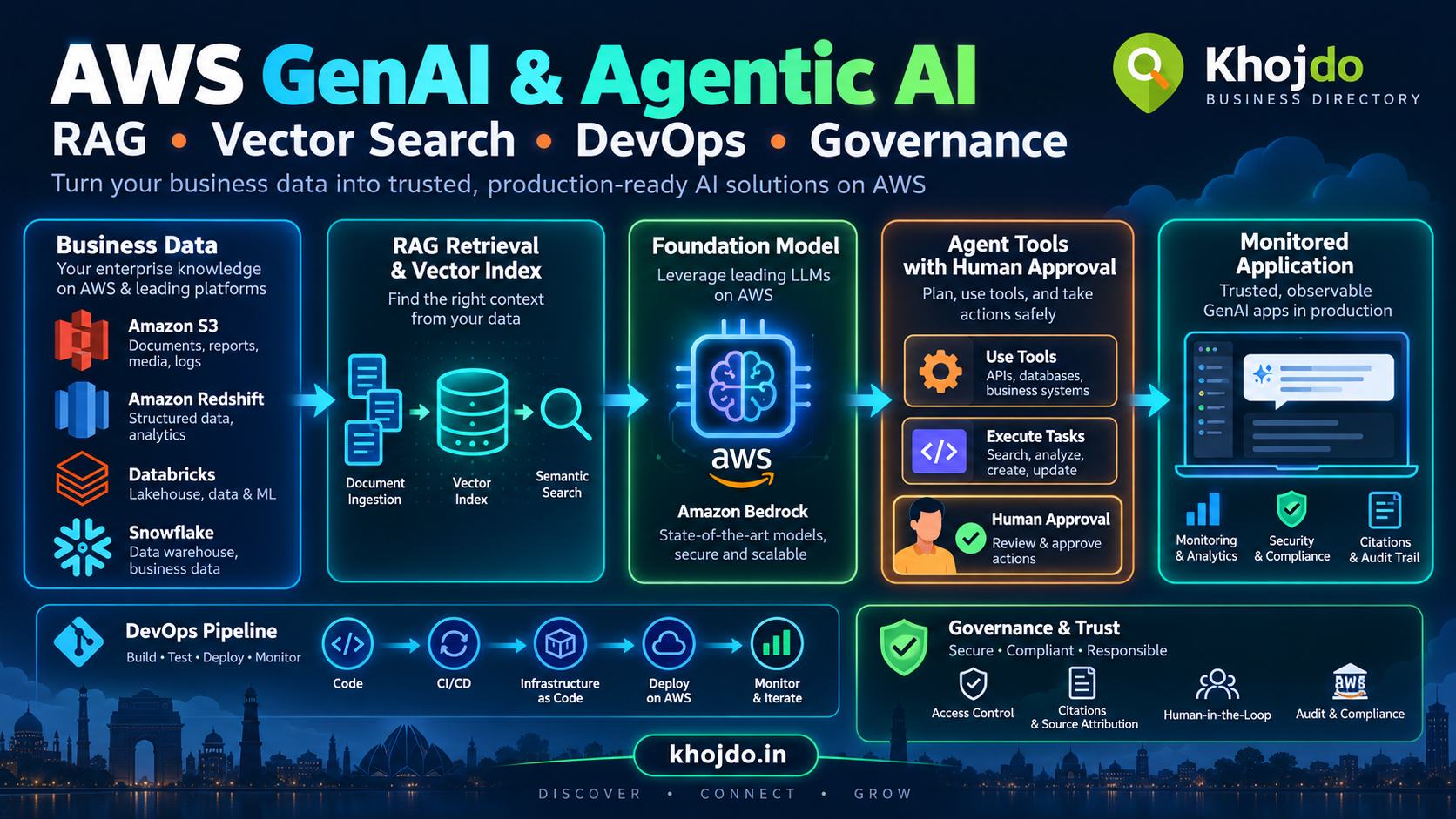
Answer: I would start with a bounded use case and trusted data sources. A RAG design ingests and chunks approved documents, creates embeddings, retrieves relevant passages and provides them to the model with instructions to answer from evidence and cite sources. On AWS, Amazon Bedrock Knowledge Bases can support this pattern; the choice of vector store should reflect retrieval quality, access filters, latency, scale and cost.
12. How would you evaluate an AI or RAG solution?
Answer: I would build a representative test set with expected evidence and answers. I would measure retrieval relevance, answer correctness, citation support, refusal behavior, latency, cost and user feedback. I would test permission boundaries and adversarial inputs as well as normal queries, and rerun evaluations when models, prompts, retrieval settings or source data change.
13. How do you make an AI agent safe to use tools?
Answer: I expose narrow, typed tools rather than unrestricted SQL or shell access. The backend validates identity, permissions and inputs, and applies business rules. I require human approval for consequential actions such as refunds or account changes, and log tool calls for audit. I treat retrieved text and user content as untrusted input.
14. How would you plan a cloud migration?
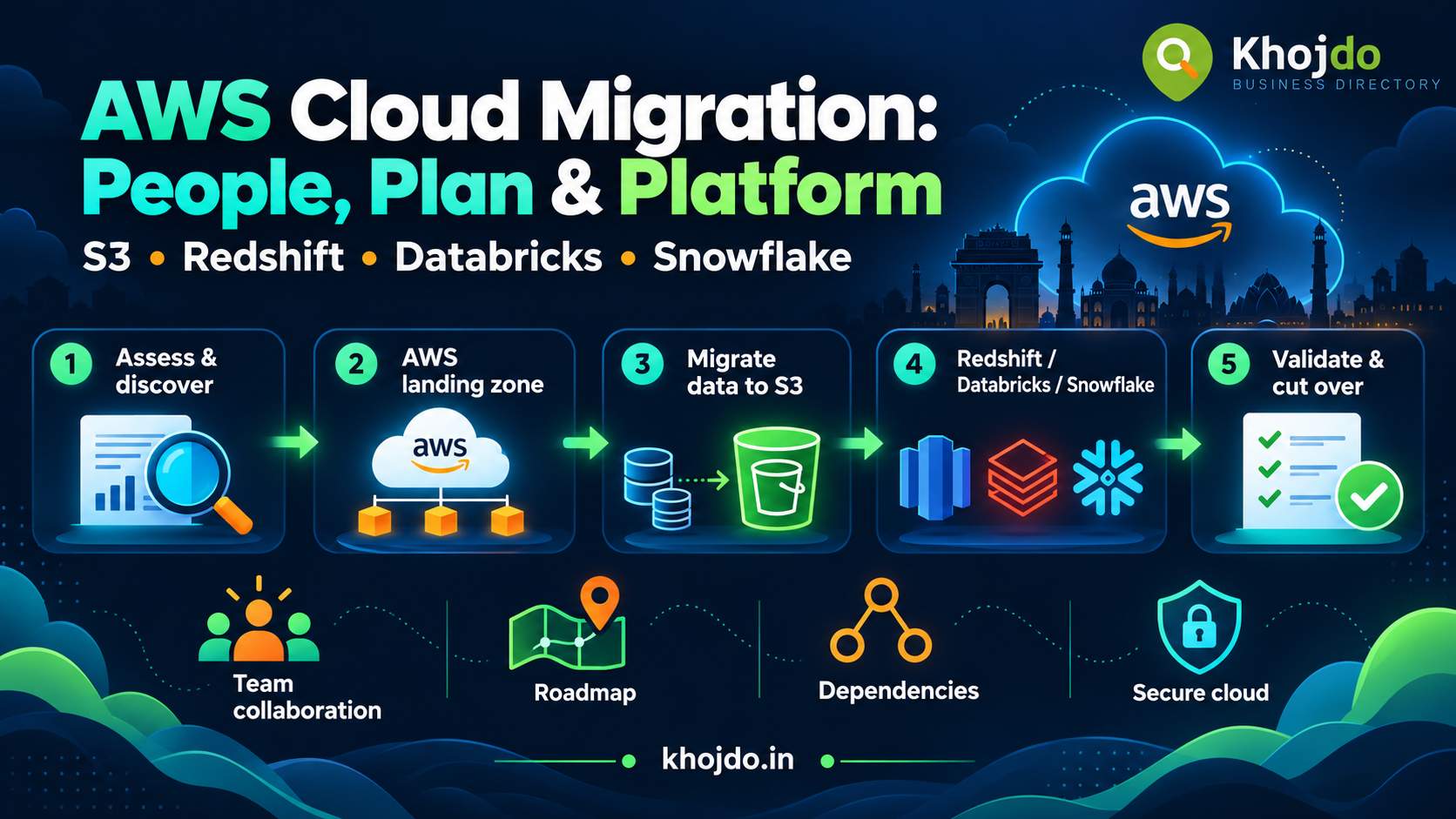
Answer: I inventory workloads, data volumes, dependencies, owners and compliance needs, then prioritize a low-risk pilot. I establish the AWS landing zone and operating model, migrate in dependency-aware waves, validate source-to-target data, rehearse cutover and define rollback criteria. I track progress, risks, costs and business outcomes after each wave.
Leadership and challenge questions
15. A source is late or unstable. What do you do?
Answer: I identify whether the bottleneck is the source, network, ingestion service or target. I protect source systems with bounded concurrency and retries, checkpoint progress, make writes idempotent, and communicate freshness impact to consumers. I offer a recovery estimate only after validating throughput and dependencies.
16. A project is behind schedule because dependencies were missed. How do you respond?
Answer: I make the impact visible, confirm the critical path and identify what decision or resource is blocking progress. I present options—reduce scope, resequence work, add capacity or revise the date—with cost and risk impacts. I update the roadmap and communicate owners and next checkpoints rather than hiding the delay.
17. How do you handle scope creep?
Answer: I keep an agreed scope baseline and assess each request for business value, effort, dependencies, risk and schedule impact. The stakeholder decides whether the change replaces existing work, adds capacity or moves a milestone. I record the decision and update acceptance criteria.
18. What is your approach to team leadership?
Answer: I align engineering, security, operations, analytics and business owners around outcomes, roles and decision rights. I keep a shared risk and decision log, encourage early escalation, coach engineers through design reviews and retrospectives, and make sure operational ownership is clear before go-live.
Best practices to mention in an interview
- Start from business outcomes, data ownership and measurable service levels.
- Use the simplest architecture that meets security, scale and reliability needs.
- Design for replay, idempotency, observability and controlled schema evolution.
- Test permissions, quality rules, performance and recovery using realistic workloads.
- Version code, infrastructure, SQL, prompts and deployment configuration; promote through reviewed environments.
- State trade-offs clearly and explain how you would validate assumptions before committing to delivery or cost estimates.
A strong Data and AI Architect answer connects technology choices to user needs, operating costs, governance and recovery. Explain your assumptions, describe how you would measure success, and show how you would adapt when the evidence changes.