Azure Fabric :: Part 2 — Petabyte-Scale Ingestion
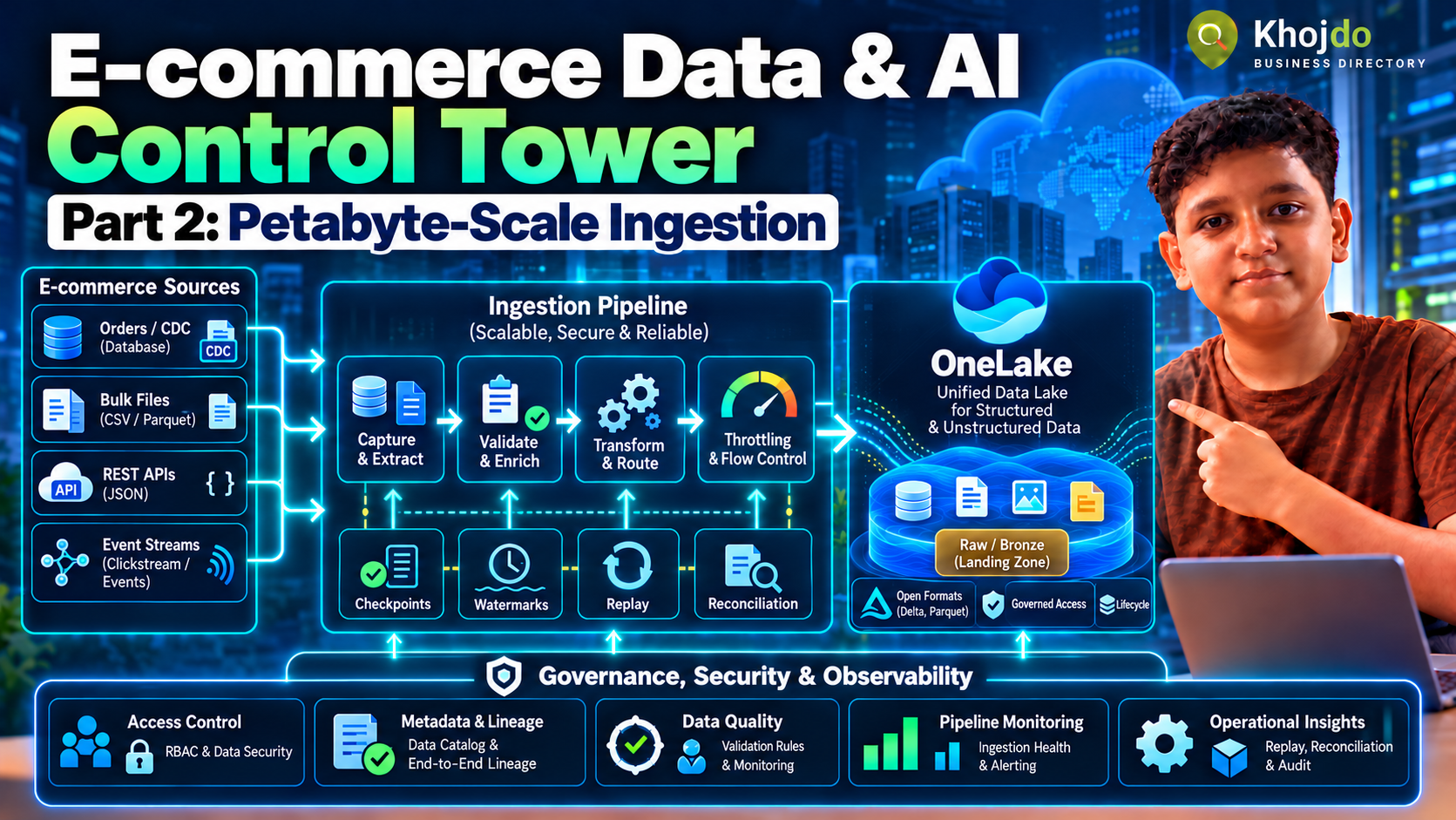
Design restartable backfills and continuous database, file, API and event ingestion with checkpoints, watermarks, retries, reconciliation and Control Tower telemetry.
Part 2: Backfill, CDC, APIs and Streams
Controlled ingestion combines checkpoints, watermarks, replay and reconciliation before downstream use.Part 1 set the architecture and planning baseline: approximately 1–3 PB of historical e-commerce data, 5–20 TB/day of changes and 15–25 source systems as an illustrative sizing scenario. This article turns that baseline into an ingestion strategy for orders, customers, inventory, payments, clickstream, partner APIs, JSON feeds and files. The focus is not a single giant copy job; it is repeatable migration waves that can resume, reconcile and feed the downstream control dashboard.
1. Choose the right movement pattern for each source
| Source/workload | Starting pattern | Use it when | Watch for |
|---|---|---|---|
| Large relational tables | Fabric Data Factory Copy Job or pipeline Copy activity; partitioned full load followed by CDC or incremental watermark | You need a controlled copy into OneLake and the connector supports the source pattern. | Source IOPS, snapshot consistency, CDC log retention, table skew and destination write behavior. |
| Supported operational database needing near-real-time analytical access | Fabric Mirroring | The source and region are supported and managed replication fits the requirement. | Per-source prerequisites, table limitations, latency, security model and mirrored storage/operations. |
| Bulk files, JSON, Parquet, images and PDFs | Copy Job schema-agnostic/binary file copy into a raw landing zone; parse separately | You need durable, replayable file landing while preserving the original bytes. | File count, tiny-file overhead, overwritten files, checksums and folder enumeration time. |
| REST/SaaS APIs | Data Factory pipeline Copy activity with REST connector and pagination | The provider exposes a supported endpoint and scheduled or incremental extraction is sufficient. | Rate limits, page/cursor expiry, Retry-After, schema changes, token refresh and API backfill cost. |
| Clickstream and operational events | Event Hubs → Fabric Eventstream → Lakehouse/Eventhouse; Databricks streaming where its stateful processing is needed | You need continuous ingestion, event-time processing or low-latency operations. | Partition-key skew, checkpointing, duplicates, late events, retention and consumer lag. |
| Already-open data in another lake | OneLake shortcut | Referencing supported open-format data in place meets access, latency and ownership requirements. | Source availability, network locality, permissions, external throttling and query-time performance. |
Use Copy Job for straightforward data movement, including supported incremental patterns. Use pipelines when movement must be orchestrated with branches, dependencies, validation or notifications. Use Eventstream for continuous events. Shortcuts and Mirroring can expose supported data without building a full custom copy path, but they are not substitutes for every transformation or migration requirement. CDC availability and preview status depend on the connector and tenant, so verify current support before committing to the design.
Unlock this series to read the rest
This article belongs to a set. One payment opens every part for the period shown.
Already bought it? Sign in with the email you paid with, or open your access link.