Solution Architect’s Interview Blueprint: AWS Energy Data Control Tower

A practical interview framework for designing a governed AWS data platform, using an energy operations control tower to explain architecture choices and mapping them to a financial-markets Unified Data Platform.
Scenario: An energy company wants an operations control tower that combines generation, smart-meter, asset, weather and market data. Operators need trusted dashboards for generation performance, asset health, demand and supply, and emerging events. The architecture must scale, protect sensitive data and support analytics and AI.
Interview context: The role is an AWS Data & Solution Architect for a Unified Data Platform. The architect owns the target design, SageMaker Unified Studio model, engine connectivity, architecture decisions and security guardrails. The client retains product, platform and control ownership, while delivery happens with an integrated co-build squad.
Architect’s principle: Start with business outcomes and operational constraints. Then explain the smallest secure, governed platform that can deliver them. Present trade-offs and decisions clearly; do not begin by listing AWS services.
Start with the business question
Before proposing a target architecture, clarify what the control tower must help people decide. For example:
- Can operators identify a generation shortfall early enough to respond?
- Can asset teams find equipment whose condition or maintenance history raises risk?
- Can planners compare actual demand with weather-adjusted forecasts?
- Can leaders trace a dashboard metric back to its source and refresh time?
Turn each question into a measurable outcome, such as reducing the time to detect an operational exception, improving the freshness of key dashboards, or increasing the percentage of data products that pass agreed quality checks. Establish baseline measurements with the client before committing to target values.
Describe the target architecture in layers
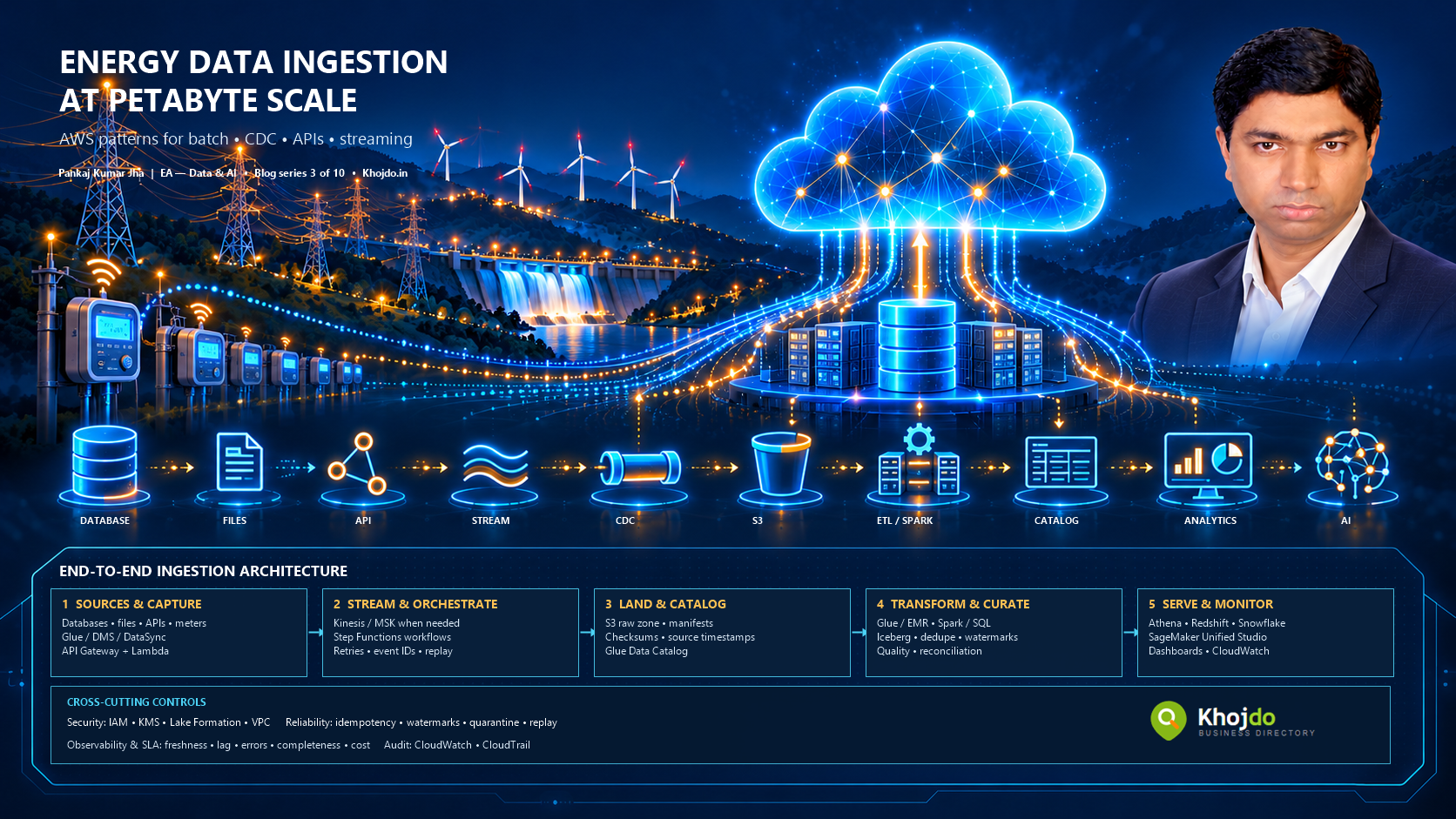
Source systems: Generation and dispatch systems, smart-meter platforms, asset-management applications, weather providers and energy-market feeds produce batch files, APIs, events and database extracts.
Landing and storage: Amazon S3 provides durable storage for incoming and curated data. Keep raw arrivals immutable where practical, record source and ingestion metadata, and separate environments and data classifications through account, bucket and prefix design.
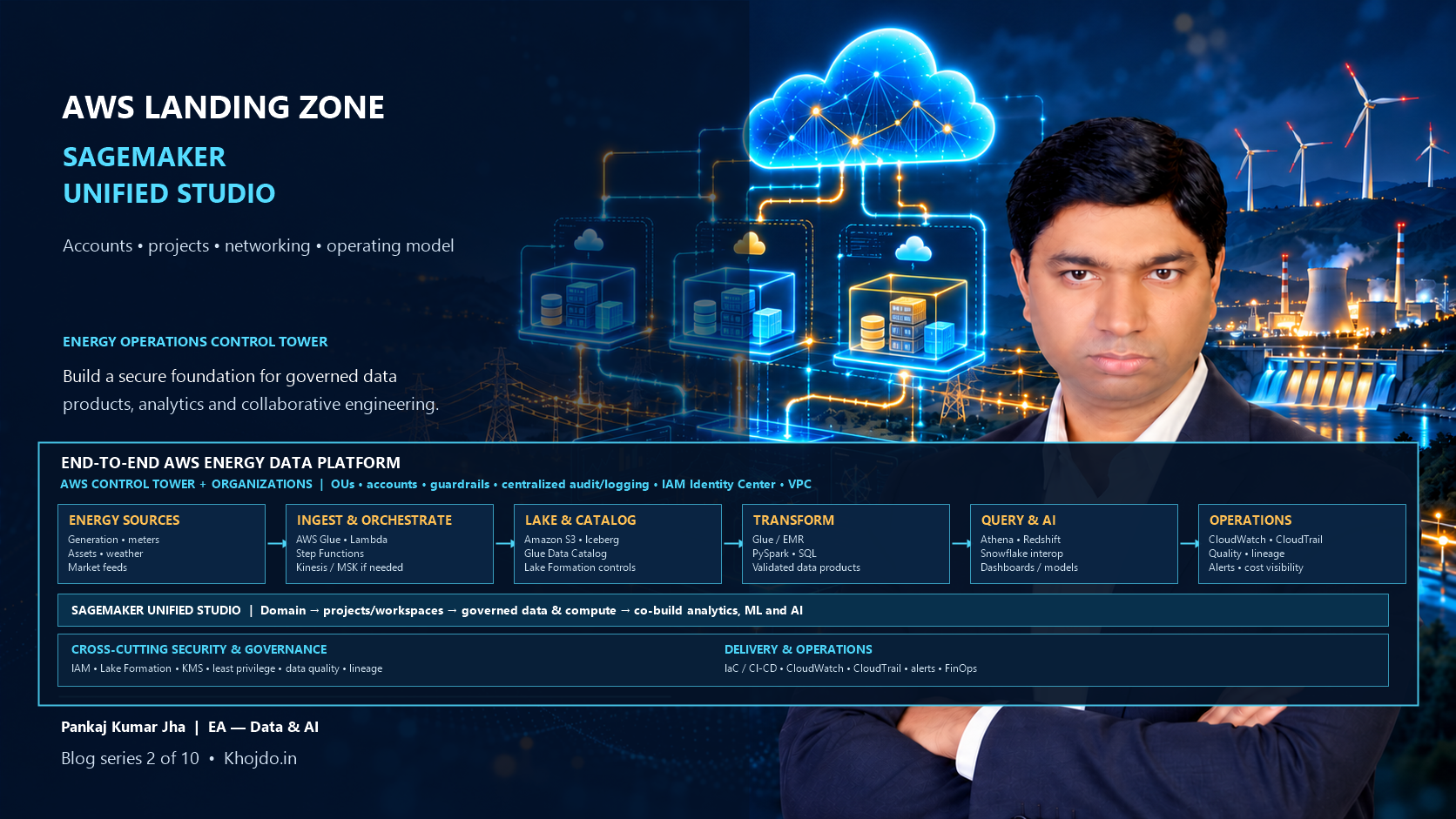
Catalog and governance: AWS Glue Data Catalog stores table metadata. AWS Lake Formation can manage permissions on catalog resources and registered S3 data locations; access also depends on the relevant IAM permissions. Design and test both permission layers together. AWS Lake Formation permissions overview
Processing and orchestration: Use the processing engine that fits the workload and operational model. AWS Glue can support managed data integration and Spark transformations; Amazon EMR can support workloads needing more control over the big-data environment. Use orchestration and event-handling services where they fit the workflow, with explicit retry, failure and replay behavior.
Consumption: Amazon Athena can support interactive queries over lake data; Amazon Redshift can support warehouse-style analytics and serving patterns; Snowflake may remain a consumer where the client has a defined interoperability requirement. Select engines by workload, service support, governance, latency, operating effort and cost—not by habit.
Workspace and collaboration: Use Amazon SageMaker Unified Studio domains and projects to organize users, assets and collaborative work. A project can serve as a boundary for a business use case, with access and resources shaped by its configuration. The domain, project, network and identity design should follow the client’s tenancy and security requirements. SageMaker Unified Studio domains · SageMaker Unified Studio projects
Operational visibility: Define pipeline, data-product and platform health signals early: last successful run, source-to-dashboard freshness, volume anomalies, quality failures, failed tasks, access events and cost trends. Specify owners and response actions for each alert.
End-to-end flow: Energy sources → S3 landing → catalog and governed access → validated and curated data products → analytics and AI workspaces → operational dashboards and decisions.
Translate the design to financial markets
The energy example is a way to make architecture decisions concrete. For the financial-markets engagement in the role profile, translate the patterns rather than assuming the data is identical:
- Generation and dispatch feeds can illustrate time-sensitive operational data; the financial-market equivalent may be market or transaction feeds.
- Smart-meter readings can illustrate high-volume, time-series records; a market design may instead handle prices, quotes, trades or other event records.
- Asset and maintenance data can illustrate reference and operational context; the financial-market equivalent may include instrument, counterparty or other reference data.
- Weather observations can illustrate external context joined to internal data; in finance, that could be another approved external or alternative data source.
In either domain, ask about event time, late arrivals, correction handling, lineage, entitlements, data quality, retention and the consumer’s service-level expectations.
Define a credible MVP
Propose a governed platform foundation plus three production pilot data products, as called for in the role profile. Select pilots with the Product Owner based on business value, data readiness, control requirements and delivery dependencies. For an energy control tower, illustrative pilots could be:
- Generation performance: actual output, planned output and validated exceptions.
- Asset health: asset events joined with maintenance history and condition indicators.
- Demand and weather outlook: demand measures aligned with weather and forecast context.
These are candidates, not assumptions. Agree on owners, source access, definitions, freshness, quality checks, consumers and acceptance criteria before committing. A financial-markets MVP should select its three pilots with the client’s business owner and control teams.
Use a repeatable interview answer structure
For an architecture question, organize the response in this order:
- Outcome: What decision or business process should improve?
- Constraints: What are the volume, latency, security, residency, availability and team constraints?
- Design: What are the main layers and data flows?
- Trade-offs: Why these services and patterns, and what alternatives were considered?
- Controls: How are identity, data permissions, quality, lineage and operations handled?
- Delivery: What can be delivered first, how will it be accepted, and what remains outside scope?
- Evidence: Which measures will demonstrate that the design works?
Example interview response: “I would first confirm the control-tower decisions, freshness expectations, data classifications and source constraints with the Product Owner. I would design an S3-centered data platform with cataloged, governed data products and a clear separation between landing, validated and consumption data. I would choose processing and query engines by workload and operational constraints, then establish workspace, identity and network boundaries for the teams. I would deliver the foundation and three client-approved pilots in increments, with architecture decisions, security assurance, traceability and run monitoring reviewed with the co-build squad.”
Show that you can lead architecture decisions
The architect’s job is not to make every choice alone. Chair a joint design authority with client and engineering stakeholders. Record important decisions as Architecture Decision Records (ADRs), including the context, options, decision, consequences, owner and review trigger.
For example, an ADR might compare a lake-first query pattern with a warehouse serving pattern for a dashboard workload. The decision should document query concurrency, latency needs, governance integration, existing skills, cost ownership and how the design can evolve if usage changes.
For cross-team delivery, maintain a shared backlog, explicit acceptance criteria, a RAID log for risks and dependencies, and a requirements traceability matrix linking requirements to designs, controls, tests and acceptance evidence. Build knowledge transfer into delivery so client engineers can operate and extend the platform after the MVP.
Address risks and trade-offs directly
- Scope grows faster than delivery: Keep an agreed MVP boundary. Route new requests through impact assessment and Product Owner prioritization.
- Source data is delayed or inconsistent: Define freshness and quality expectations per product; surface late or invalid data rather than silently presenting stale results as current.
- Access is too broad or too restrictive: Test end-to-end access with the actual roles and query engines. Lake Formation and IAM checks both matter for governed access. AWS Lake Formation permissions overview
- Too many engines create support burden: Approve a small set of workload patterns and require an ADR for exceptions.
- The platform is built without adoption: Name product owners and consumers, validate dashboard definitions, and measure usage and operational outcomes.
- Cost or performance targets are vague: Establish baselines, identify cost owners and agree on workload-specific service levels before tuning.
Close with a clear architecture position
A strong Data Architect interview answer connects business outcomes to platform choices, controls and a deliverable plan. In this example, the energy control tower makes data flow and operational decisions tangible. For the AWS Unified Data Platform engagement, carry the same method into financial-market workloads, align with the client’s ownership model, and show how the foundation can deliver three governed production pilots.
Interview takeaway: Explain what the business needs, how the architecture meets it, why the trade-offs are acceptable, how the client will control and operate it, and what evidence will show success.
Continue the series
Next: 2. AWS Landing Zone and SageMaker Unified Studio: Building the Energy Control Tower Foundation — account boundaries, project workspaces, networking and the operating model.