
How to choose a Mithila painting artist for a commission
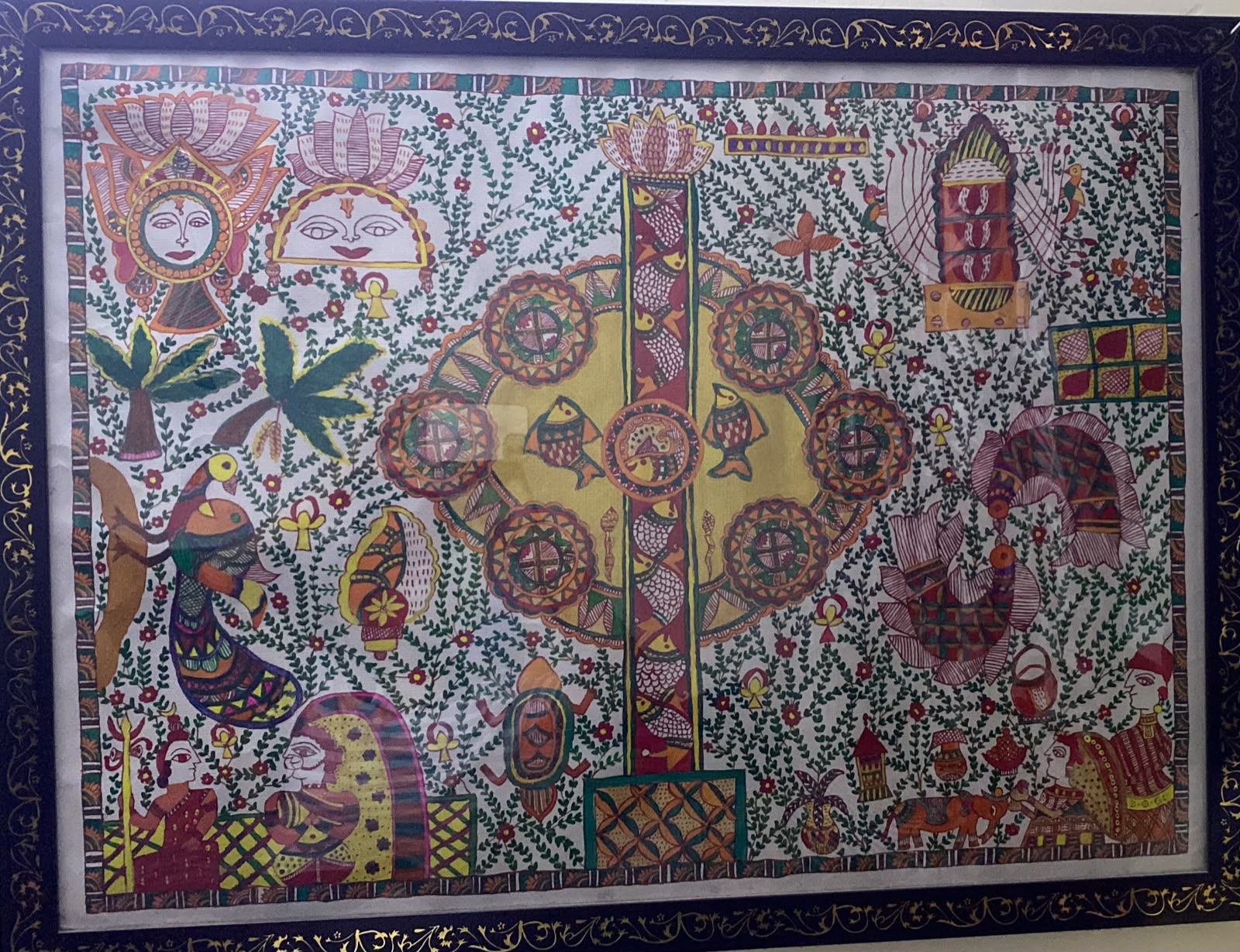
What to ask about style, materials and timelines before you pay an advance for Madhubani art.
Mithila painting is not one style. Knowing which one you want saves everyone a difficult conversation later, and it gets you a better piece for the same money.
Bharni, Kachni, Godna, Tantrik
Bharni uses filled colour blocks and bold outlines. It photographs well, reads from across a room, and is the style most people picture when they think of Madhubani.
Kachni is line work, usually monochrome, built from very fine hatching. It rewards close viewing and takes considerably longer for the same size, which is why a Kachni piece costs more than a Bharni one of identical dimensions.
Godna takes its vocabulary from tattoo patterns - repeated figures in rows, sparse and rhythmic. Tantrik work uses religious iconography and is usually commissioned for a specific purpose rather than for decoration.
Kohbar is not a style but a subject: the wedding chamber painting, full of fertility symbols - lotus, bamboo, fish, the sun and moon. If the painting is a wedding gift, ask for a Kohbar specifically.
Give the artist a brief, not just a size
The more an artist knows about where a painting will live, the better it will fit. Tell them four things.
- Where it will hang, and whether that wall gets direct sunlight
- The occasion, if there is one - a wedding, a housewarming, a corporate gift
- Any motif that matters to you, and anything you would rather avoid
- Whether it will be framed, and if so in what
Artists will usually send a rough layout before starting. Ask for one. Changing a composition on paper costs nothing; changing it after the ink is down costs the whole piece.
Ask about materials
Handmade paper, canvas and cloth all age differently. Natural pigments look softer but need framing under glass. Acrylic holds colour longer on a wall.
Natural pigments are the traditional choice - lampblack for black, turmeric for yellow, indigo for blue, kusum flower for red. They have a depth that acrylic does not, and they fade in sunlight. If you want natural pigment, plan on UV glass and a wall that does not face a window.
Handmade paper is the usual support and is what most collectors expect. Canvas suits larger pieces. Cloth travels and rolls well, which matters if the painting is going abroad.
Fair timelines, and what drives them
A detailed A2 piece takes two to three weeks of actual work. Anyone promising a large commission in three days is either subcontracting it or printing it.
What actually sets the timeline is density, not size. Traditional Mithila work leaves no empty space - the background is filled with fish, birds, leaves and geometric fill. A sparse A1 can be quicker than a dense A3.
Add a week in the run-up to Chhath and the wedding season, when every working artist in Madhubani and Darbhanga is booked.
How to tell handmade from printed
- Hold it at a shallow angle to the light - brushwork sits on the surface, print does not
- Look at the double-line outline, the signature of Kachni and Bharni. In handwork the two lines wobble independently
- Check the back. Natural pigment on handmade paper bleeds through slightly; a print does not
- Ask for a photograph of the piece in progress. Any genuine artist has them
What a fair price reflects
Style, density, size, pigment and the artist's standing - in roughly that order. Kachni costs more than Bharni. Natural pigment costs more than acrylic. A named artist with exhibition history costs more than an equally skilled unknown, and that is not a markup you are being cheated by, it is the market working normally.
Ask for half the payment up front and half on completion. That is the usual arrangement and protects both sides.
Looking after it
- Frame under glass if it is natural pigment, with a mount so the surface never touches the glass
- Keep it off walls that get direct afternoon sun
- Dust the frame, never the painted surface
- If it arrives rolled, let it sit flat under weight for a few days before framing
Buying from the region
Mithila painting comes from the Mithila region of north Bihar and the Terai across the border in Nepal, and was painted on the walls of homes long before it was ever on paper. It moved onto paper in the 1960s, when artists were given sheets to work on and a wall tradition became something that could be sold and carried. Buying directly from an artist in Madhubani, Darbhanga or Saharsa keeps that money where the tradition lives.