Azure Fabric :: E-Commerce Data & AI Control Tower — Part 4: Agentic AI for Cost, Time and Operations
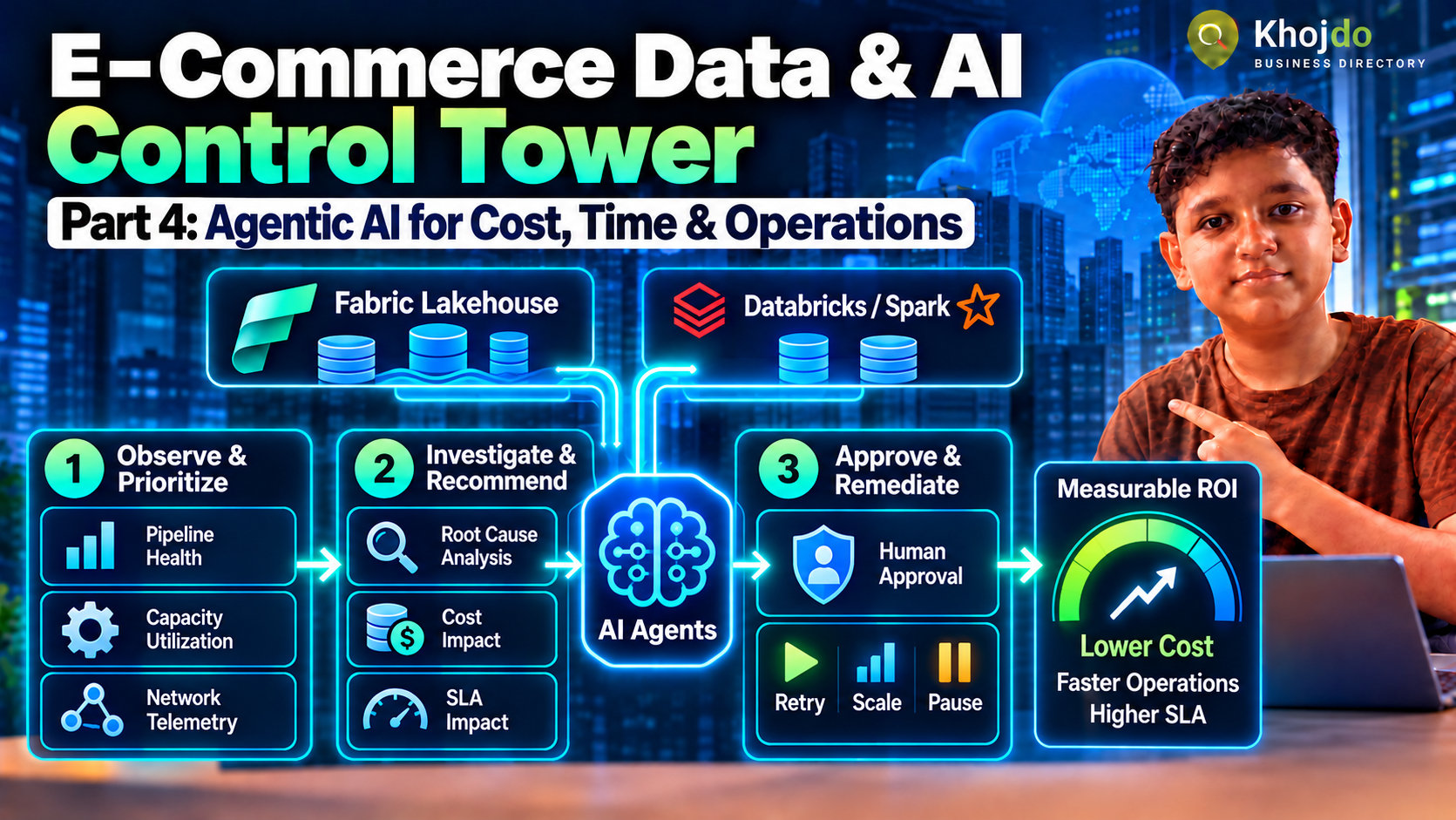
Use a guarded agentic AI operations layer to prioritize data incidents, investigate pipeline, capacity and network signals, and recommend or carry out approved fixes with measurable ROI.
Series: E-Commerce Data & AI Control Tower — Part 4 of 6
Scenario: An international e-commerce platform runs petabyte-scale batch and streaming pipelines across Microsoft Fabric OneLake and Azure Databricks. It needs a control tower for pipeline health, data freshness, capacity, network performance, data quality and AI-agent operations. Volumes and ROI figures in this article are illustrative; validate them against measured workload and current service pricing.
How agentic AI can help: three steps
An operations agent should move through three controlled steps. It can save investigation time by correlating signals and presenting evidence; production changes should remain bounded by policy and approval rules.
- Step 1 — Observe and prioritize: read approved telemetry, correlate a failed job with upstream lag, recent schema changes, capacity pressure and downstream SLA impact, then rank incidents by business impact.
- Step 2 — Investigate and recommend: assemble run history, logs, lineage, resource use and recent deployments; explain likely causes with links to evidence and propose low-risk next actions.
- Step 3 — Approve and remediate: request operator approval for consequential changes, then call only allow-listed actions such as replaying an idempotent partition, opening an incident or pausing a noncritical schedule. Verify the outcome and record the action.
Unlock this series to read the rest
This article belongs to a set. One payment opens every part for the period shown.
Already bought it? Sign in with the email you paid with, or open your access link.